

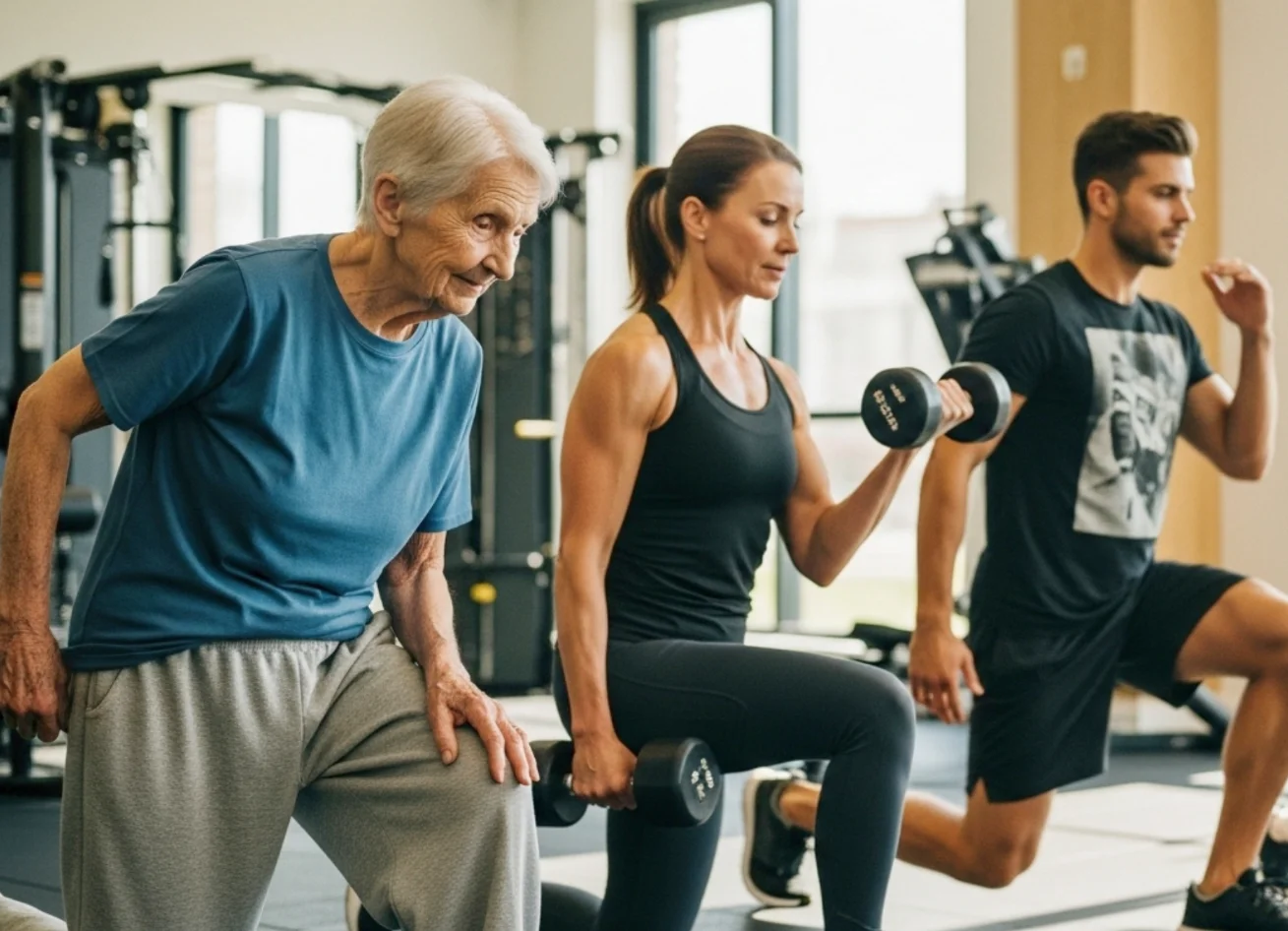
Your body’s needs change dramatically every decade. Understanding these shifts determines whether you maintain peak performance or accelerate decline.
Why Age-Specific Training Matters
Physical capabilities peak between ages 25-30, then begin systematic decline. VO2 max drops 10% per decade in sedentary individuals but only 5% in those who maintain vigorous training. Muscle mass decreases 3-8% per decade after age 30, with strength declining even faster at 3-4% annually after 75. These changes aren’t inevitable—strategic training significantly slows deterioration.
The key difference: younger bodies respond to almost any stimulus, while aging bodies require precise interventions targeting specific decline mechanisms.
Your 20s: Build Your Foundation
Peak physiological capacity occurs now. Human growth hormone levels reach 6ng/ml at age 20 compared to 3ng/ml by 40. Testosterone remains elevated, muscle recovers rapidly, and metabolic rate vaporizes calories.
Training Focus
Heavy compound lifting builds maximum muscle mass and bone density that protects you for decades. Focus on squat, bench press, and deadlift with low reps (3-6) and high weight (80-90% of one-rep max).
High-intensity cardio establishes cardiovascular capacity. HIIT workouts combining 30-second all-out efforts with brief recovery periods maximize VO2 max gains. Research shows HIIT produces comparable aerobic improvements to 60-minute steady-state sessions but requires only 4 minutes of intense work.
Weekly Structure
- 3x strength training: Full-body compound movements, progressive overload
- 3x cardio: Mix HIIT (15-20min) with longer endurance sessions (45-60min)
- Flexibility work: Basic mobility exercises post-workout
Key Mechanisms
Your body synthesizes muscle protein at peak efficiency. Fast-twitch muscle fibers (responsible for explosive power) respond maximally to training stimulus. Building muscle mass now creates reserves that offset inevitable later decline.
Critical mistake: Neglecting mobility and functional movement. Joint health accumulated now determines movement quality at 50.
Your 30s: Maintain and Adapt
Muscle mass peaks between 30-35, then begins gradual decline. Power output drops 7-14% per decade even in active individuals. Metabolism slows as muscle mass decreases, making weight management more challenging.
Recovery takes longer. Injuries from poor form become more common. Family and career demands reduce available training time.
Training Focus
Hypertrophy training combats muscle loss through 3-4 sets of 10-12 reps at moderate-to-heavy loads. This triggers sarcomeric hypertrophy—increasing contractile proteins that make muscles bigger and stronger.
Zone 2 cardio maintains cardiovascular base. Calculate maximum heart rate (220 minus age), then train at 60-70% of that number. For a 30-year-old: 114-133bpm sustains fat oxidation and builds aerobic capacity without excessive recovery demands.
Weekly Structure
- 3-4x strength training: Split routines targeting all major muscle groups
- 2-3x cardio: One HIIT session (15min), two steady-state sessions (30-45min)
- 1x mobility/yoga: Active flexibility work and core strengthening
Key Mechanisms
Lactate threshold (the point where fatigue-producing lactate accumulates faster than clearance) still responds well to training. Extending this threshold maintains endurance performance despite declining VO2 max.
Resistance training at 50-85% of one-rep max for 6-12 reps maintains muscle protein synthesis rates and prevents the anabolic resistance that emerges later.
Your 40s: Strategic Preservation
Sarcopenia (age-related muscle loss) accelerates. Muscle mass decreases 5lb per decade on average. Bone density declines, particularly in women approaching menopause. Metabolic rate drops as muscle mass shrinks.
Joint integrity becomes paramount. Injuries heal slower. The window between optimal training stimulus and overtraining narrows.
Training Focus
Full-body resistance training preserves functional capacity. Multi-joint exercises (deadlifts, squats, rows, presses) maintain coordination between muscle groups while maximizing efficiency for time-pressed schedules.
Core strengthening protects against back pain, which commonly emerges this decade. Plank variations, dead bugs, and anti-rotation exercises build the stability crucial for all movement.
Weekly Structure
- 3x full-body strength: Emphasis on form over ego, compound movements
- 2-3x cardio: Mix intensities—one HIIT session, two moderate sessions
- 2x mobility/Pilates: Spinal health and range-of-motion preservation
Key Mechanisms
Resistance training intensity matters more than volume. Studies show 10 weeks of resistance training increases lean weight by 1.4kg, boosts resting metabolic rate by 7%, and decreases fat weight by 1.8kg—critical for counteracting metabolic slowdown.
Women entering perimenopause face estrogen decline, accelerating bone density loss. Weight-bearing exercise during this window significantly reduces osteoporosis risk.
Your 50s+: Functional Fitness and Longevity
After 50, muscle mass decreases 1-2% annually. Strength declines 1.5% between ages 50-60, then 3% annually thereafter. Balance deteriorates. Fall risk increases—falls cause leading injuries in adults 65+.
VO2 max continues declining, but masters athletes maintaining training lose only 5% per decade compared to 10% in sedentary peers. Mitochondrial density and function become limiting factors more than cardiac output.
Training Focus
Power training preserves fast-twitch muscle fibers that decline most rapidly. Use 40-60% of one-rep max performed at higher velocities. Box step-ups, medicine ball throws, and kettlebell swings maintain explosive capacity needed for daily activities.
Balance work prevents falls. Single-leg exercises, tandem stance holds, and stability ball exercises maintain proprioception and coordination.
Weekly Structure
- 3x strength/power training: Lower weights, explosive movements, full recovery
- 3-4x cardio: Mostly low-impact (swimming, cycling, walking), one HIIT session if tolerated
- 2-3x balance and mobility: Essential for maintaining independence
- 1x sensorimotor training: Recent research shows this most effectively improves physical function in adults 55+
Key Mechanisms
Sensorimotor training (exercises optimizing nervous system-muscle communication) produces the greatest improvements in balance, strength, and mobility among older adults. This beats traditional aqua aerobics and Pilates for functional fitness.
HIIT remains beneficial with proper supervision. Research shows HIIT improves cognitive function in adults 65-86, with benefits persisting 5 years after training. The protocol: four 4-minute intervals at 85-95% maximum heart rate with 3-minute recovery periods.
Protein intake becomes more critical. Aging muscles develop anabolic resistance—reduced response to protein and exercise stimuli. Higher protein intake (1.2-1.6g per kg body weight) combined with resistance training maintains muscle protein synthesis.
The Bottom Line
- 20s: Build maximum muscle mass and bone density through heavy lifting and intense cardio—this creates reserves for later decades
- 30s: Combat early decline with hypertrophy training and zone 2 cardio while managing increased life demands
- 40s: Preserve function through strategic full-body strength training, core work, and mixed-intensity cardio
- 50s+: Prioritize power training, balance work, and sensorimotor exercises to maintain independence and prevent falls
- All ages: Progressive overload, proper recovery, and consistency matter more than any specific protocol
Adapting training to your physiological age isn’t weakness—it’s strategic optimization that extends your active years and preserves quality of life.